
Access information about biodiversity in the Highlands, as well as Scotland and the UK, from the National Biodiversity Network.
National Biodiversity Network
Access HBRG Records on the National Biodiversity Network
NBN Websites:
News and Networks
Map a species’ distribution
Enter the English or Scientific name of a species to create a map from NBN records
Spotlight on…
HBRG’s contribution to NBN (April 2026)
Author: Richard Aspinall
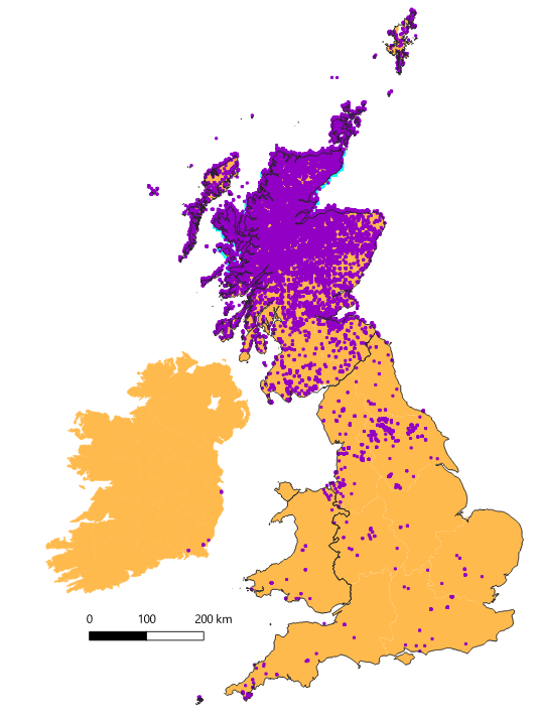
By February 2026, the Highland Biological Recording Group has added more than 300,000 records to the database of the National Biodiversity Network for the UK (see the map, right). Over 250,000 of these are for Highland Region. This places HBRG fifth in the table of groups and organisations providing records for Highland, and 9th for the UK.
HBRG records have so far included 10,928 species, fully half of all the species recorded in Highland. One in 8 of these species recorded in Highland have only been recorded by HBRG members.
For 5,941 species, 25% of the total number of species in Highland, more than half their records have come from HBRG.
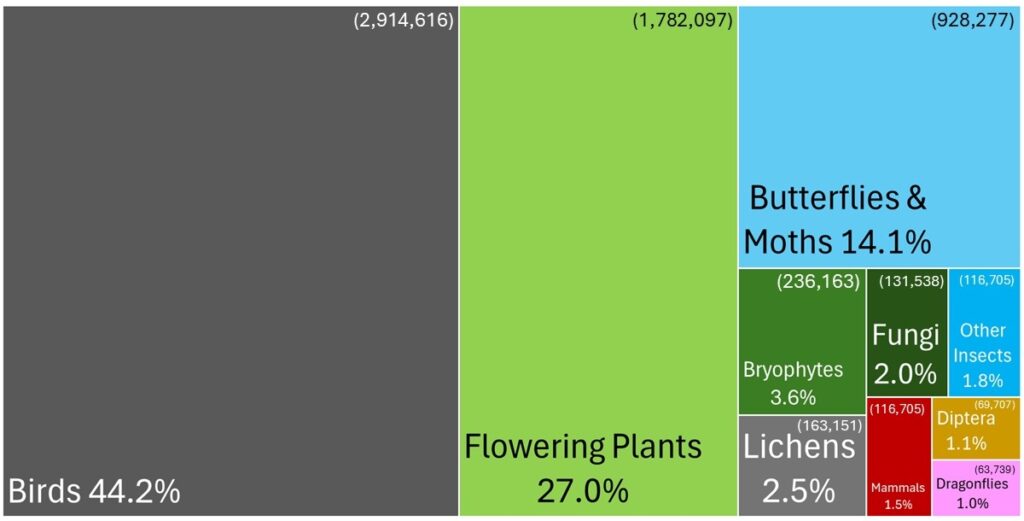
The species groups recorded in the NBN for Highland are shown on the left (organised by percentage of the total number of records). Birds, Flowering Plants, and Butterflies and Moths make up more than 85% of the data for Highland.
HBRG does not regularly record birds and vascular plants, which are the focus of other organisations and groups.
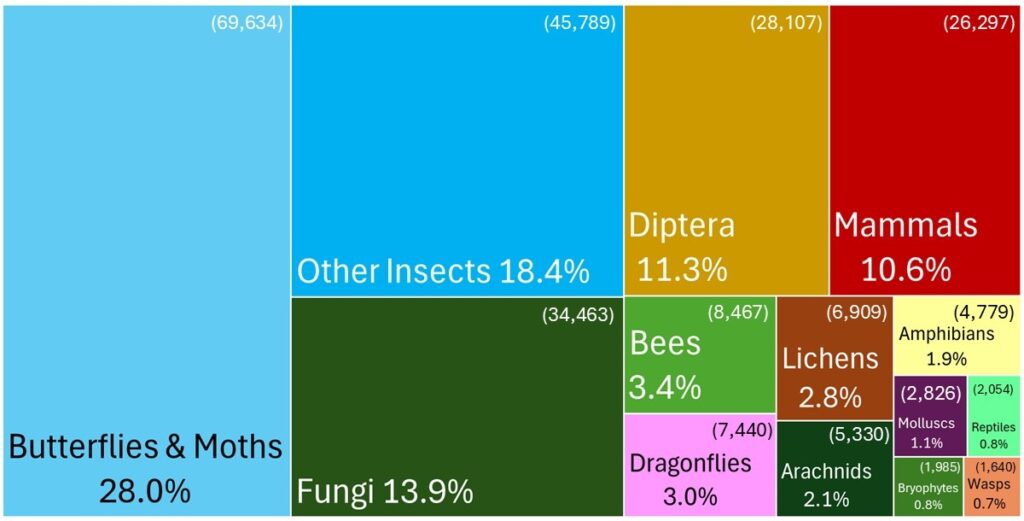
The species groups recorded by HBRG are shown on the right (by percentage of the number of records from HBRG). HBRG records mosses, lichens, and fungi, as well as invertebrates, including slugs and snails, spiders, and all insect taxa. Many of these taxa have very large numbers of species.
Although some of the taxa are among the less charismatic and obvious, they provide vitally important ecological functions, and are core to the benefits provided by biodiversity.
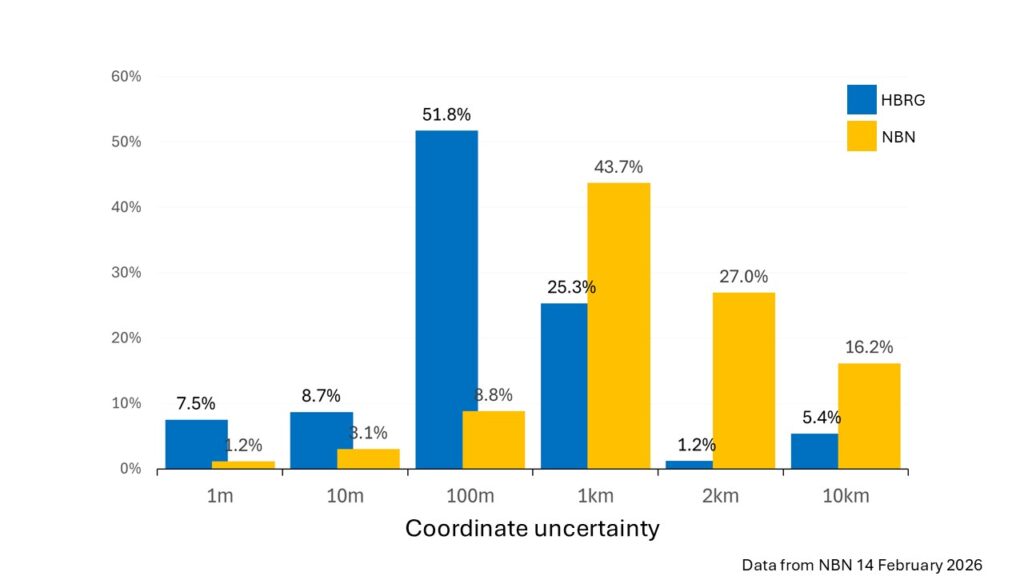
The specificity of the geographic location for HBRG records is also high. 94% of HBRG records are positioned to 1km or less versus 44 of NBN records, and 51.% are to 100m or less (v 13.1%).
Spotlight on Tree-related Aphids (April 2026)
Author: Alan Inman
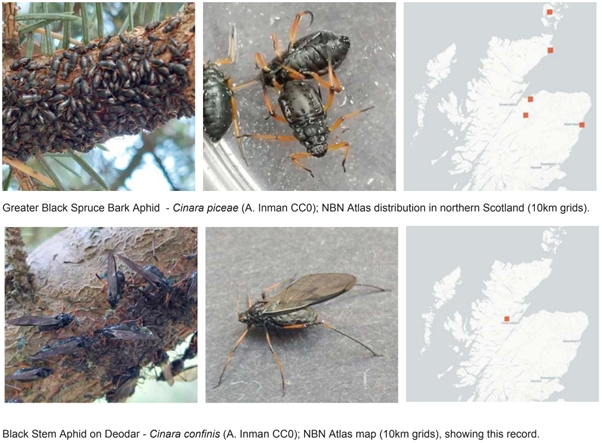
If you’re a gardener, you probably won’t be a fan of aphids. Nor if you like Sitka spruce and saw them seriously defoliated this year by the Green Spruce Aphid (Elatobium abietinum), though they’ll recover. The aphid is tiny, about 1-2 mm long, but produces a toxin when it feeds, causing defoliation. It is native to continental Europe, hence Norway spruce tolerates it well compared to the non-native Sitka, which doesn’t have a shared evolutionary history. I’m not normally an ‘insect’ person, but two species of Giant Conifer Aphids impressed me last summer and were something I’ve not seen before (at this point I must acknowledge identifications by Forest Research entomologists). They really are quite giant and feed via the bark of their hosts. Firstly, the Greater Black Spruce Bark Aphid (Cinara piceae) on a Sitka spruce at Carrbridge, which I thought were beetles at first, moving rather creepily when disturbed. And secondly, the Black Stem Aphid (Cinara confinis) on Himalayan cedar (Deodar) near Fairburn. Both are very scarce in recording terms within Highland, so more records would be great.
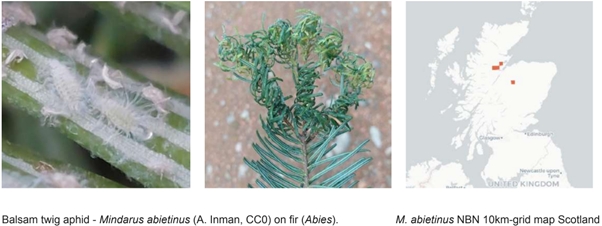
The Balsam Twig Aphid (Mindarus abietinus) on fir is also not well recorded in Highland and can cause notable leaf curling. The three previous Highland records were from Stephen Moran and Murdo Macdonald. These new records are from the Black Isle area. Under a hand lens you might spot graceful strands of wax. The Mindarus species damaging firs in North America was thought to be M. abietinus but is now considered to be M. pinicola. There is a risk that an introduction of M. pinicola to the UK might be missed if misidentified as M. abietinus.
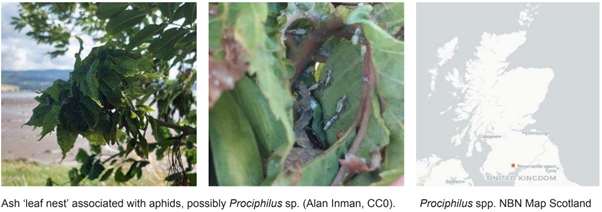
As another interesting curiosity, broom-like leaf masses and leaf curl symptoms were observed on ash in August. They were thought to be caused by a Leaf-nest Aphid. The nest was abandoned when observed, but Forest Research thought the remains of aphids in the leaf-nests could belong to a species of Prociphilus, a genus that causes this type of pseudo-gall. If this was a Prociphilus species, several are known in the UK on ash, e.g. P. fraxini or P. bumeliae (which alternate from ash leaves to fir roots), or P. fraxinifolii (which alternates between leaves and roots on ash alone). These are another rarity and Leaf-nest Aphids are worth looking out for and recording. As a genus they typically have a primary or single broad-leaved host (causing leaf nests), and most then have an alternate conifer host (feeding on roots).
To dive deeper, see: Influential Points website